Historic Walls of Dubrovnik: Your Complete Guide to Walking the Fortifications
The Historic Walls of Dubrovnik form one of Europe’s most impressive medieval defensive systems, completely encircling the UNESCO-protected Old Town. This 2-kilometer (1.25-mile) stone fortification offers panoramic views of terracotta rooftops and the Adriatic Sea. This guide provides essential tips for tickets, routes, and capturing the best photos of this iconic landmark.
Essential Wall History and Architecture
The first fortifications around Dubrovnik date from the 8th century. The current structure evolved over centuries, primarily between the 12th and 17th. The walls were continually strengthened to protect the wealthy Republic of Ragusa from invasions.
Their formidable design includes a main wall, sixteen towers, six bastions, two angular fortresses, and three moats. The Minčeta Tower, Revelin Fortress, and Bokar Fortress were key strategic points. They successfully defended the city for over five hundred years.
Architectural Features and Strategic Design
Walking the ramparts reveals brilliant military engineering. The walls are 4-6 meters (13-20 feet) thick on the landward side. They are 1.5-3 meters (5-10 feet) thick facing the sea.
- The Minčeta Tower, the highest point, provided critical observation over northern approaches. Its circular design deflected cannonball impacts effectively.
- The Lovrjenac Fortress, located outside the western wall, was a key independent stronghold. It controlled maritime access and land approaches.
- The Bokar Fortress is a prime example of a proto-bastion. It was designed to house cannons and protect the city’s main gate and harbor.
- Standard adult tickets cost 35 EUR (approx. $38) during high season (April-October). Children aged 7-18 and students with ID receive a discount, paying 15 EUR (approx. $16).
- The Dubrovnik Pass is excellent value. For 35 EUR (approx. $38) for 1 day, it includes wall entry plus free public transport and admission to several museums. This effectively makes the walls “free” with added benefits.
- Guided tours add 15-25 EUR ($16-$27) to the base ticket cost. These provide rich historical context. Private photography tours focus on composition and lighting for an additional fee.
- Dubrovnik Travel – Official Tourist Board
- UNESCO World Heritage Centre – Old City of Dubrovnik
The Walls in Modern History
The fortifications faced their most severe modern test during the Croatian War of Independence (1991-1992). The city endured significant shelling, damaging many historic buildings. UNESCO-led restoration projects began immediately after the conflict ended.
Extensive repairs restored the walls to their former glory. The reconstruction used traditional methods and original stone when possible. Today, the structure stands as a powerful symbol of resilience.
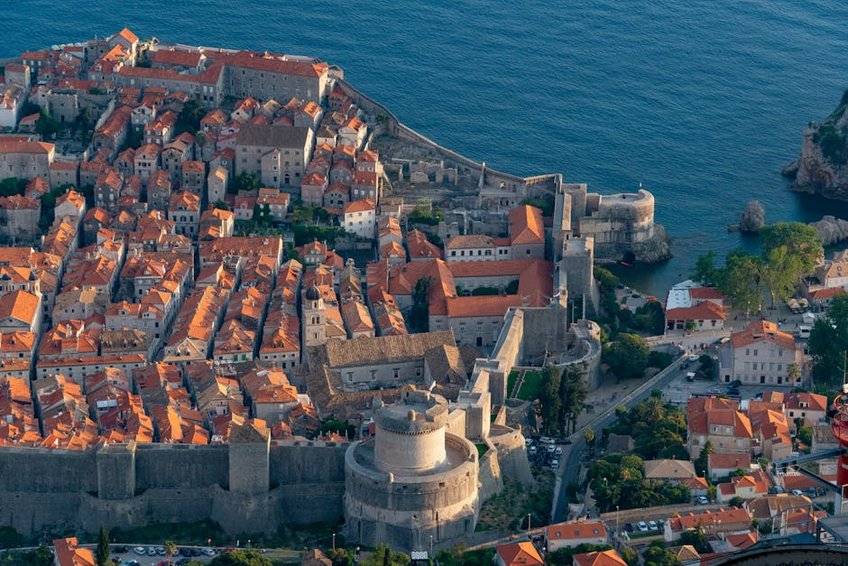
Alt: “dubrovnik-city-walls-aerial-view-old-town-adriatic-coast”
Historic Walls of Dubrovnik – Planning Your Visit
Access to the walls is controlled via several entrance gates. The main gates are found by the Pile Gate, the Ploče Gate, and near the Maritime Museum. A single ticket grants you a one-time circuit walk on the ramparts.
Your visit to the Historic Walls of Dubrovnik requires careful timing to avoid heat and crowds. Summer months see enormous cruise ship passenger traffic. This creates significant congestion on the narrow walkways.
Purchase tickets online in advance during peak season. This lets you bypass long queues at the physical ticket offices. The official Dubrovnik City Walls website is the most reliable source.
Best Time to Visit the Fortifications
The optimal months are May, early June, September, and October. Daytime temperatures range from 20-26°C (68-79°F). Crowds are noticeably smaller compared to the July-August peak.
For the best experience, enter right at the 8:00 AM opening time. Alternatively, go in the late afternoon around 4:00 PM or 5:00 PM. This timing avoids the midday sun and major tour groups.
Budget Planning and Costs
Ticket prices are the primary cost for this attraction. Other expenses include water, snacks, and potentially a guide.
Essential Preparation Checklist
Wear sturdy, comfortable walking shoes with good grip. The stone steps are often smooth and uneven. Sandals or heels are highly impractical and unsafe for the full circuit.
Carry a reusable water bottle. You can refill it at a few designated spots along the route. Bring sun protection: a hat, sunglasses, and high-SPF sunscreen are mandatory in summer.
Walking the Circuit: Routes and Highlights
The full walk is approximately 2 kilometers (1.25 miles). It involves climbing over a thousand steps. Most visitors complete the loop in 1.5 to 2 hours at a leisurely pace with stops.
The route is one-way, moving counterclockwise. You cannot backtrack once you begin. Several exit points allow you to leave early if needed, but re-entry is not permitted.
Must-See Highlights and Photo Spots
The view from the Minčeta Tower is the undisputed pinnacle. You can see all of Dubrovnik’s Old Town and Lokrum Island. Arrive early to photograph this spot without crowds.
The seaside section between the Bokar Fortress and Revelin Fortress offers stunning coastal vistas. You can watch waves crash against the rocks below. This is particularly beautiful during the golden hour before sunset.
Look down into the Old Town’s cloistered gardens and courtyards. The perspective reveals hidden architectural details. The Stradun, the main street, looks completely different from above.
Hidden Details and Viewpoints
Pause at the small niches and cannon ports along the outer wall. They offer perfectly framed views of the Adriatic Sea. These spots provide respite from the main pedestrian flow.
Notice the contrasting textures of the stone. The lighter-colored sections indicate post-1990s restoration work. The darker stone is original, weathered by centuries of sun and sea air.
Accessibility and Physical Considerations
The walk is not suitable for those with severe mobility issues or a fear of heights. There are no elevators or ramps. The path is consistently narrow, steep, and exposed.
If you have limited mobility, consider viewing the walls from below. Walking around the exterior base offers impressive perspectives. The Buža Bar cliffs also provide a magnificent side view.
Practical Travel Information for Dubrovnik
Dubrovnik’s primary airport (DBV) is about 20 kilometers (12 miles) south of the city. Numerous European airlines offer direct seasonal flights. The airport bus and taxis provide easy transfers to the city center.
Accommodation ranges from luxury hotels to private apartments. Staying within the Old Town walls is atmospheric but can be noisy. Neighborhoods like Lapad and Ploče offer quieter alternatives with excellent bus links.
| Accommodation Type | Location & Features | Price Range (USD per night) |
|---|---|---|
| Old Town Apartment | Historic building, central, stairs, potential noise | $120 – $300+ |
| Boutique Hotel (Ploče) | Seaside views, upscale, short walk to Pile Gate | $250 – $500+ |
| Guesthouse (Lapad) | Residential area, beaches, family-run, bus access | $80 – $180 |
| Hostel | Basic dorm or private room, social atmosphere | $25 – $70 |