

Airbnb vs Hotel: Finding Your Ideal Accommodation
Choosing where to stay is a fundamental travel decision. The debate between Airbnb and hotels involves weighing factors like privacy, amenities, consistency, and local immersion. Your accommodation impacts your budget, daily itinerary, and overall experience. This guide breaks down the pros, cons, and key considerations for both options across various travel scenarios.
Understanding Your Accommodation Options
Accommodation types have evolved far beyond simple hotel rooms. Short-term rentals offer entire homes, private rooms, or unique stays like houseboats. Hotels range from budget chains to luxury resorts with full service. The best choice depends on your travel style, group size, trip duration, and personal priorities.
Your decision influences daily logistics, including check-in flexibility, space for relaxing, and access to services like daily cleaning. Understanding the core differences helps you match the lodging to your trip’s purpose, whether it’s a romantic getaway, family vacation, or business conference.
The Evolution of Short-Term Rentals
The vacation rental market has grown rapidly over the past decade. Platforms like Airbnb and Vrbo popularized access to private homes. This shift gave travelers alternatives to traditional hotel stays. These rentals now include diverse properties worldwide.
- Whole-Home Rentals: You book an entire apartment, house, or villa with private kitchens and living spaces, ideal for families or groups seeking independence and communal areas.
- Private Rooms: Similar to a traditional bed-and-breakfast, you rent a room within a host’s home, offering a local touch and lower cost but less overall privacy.
- Unique Stays: Platforms list non-traditional lodgings like yurts, tiny homes, or historic properties, catering to travelers seeking a novel experience beyond a standard room.
- Budget Option: For budget stays, consider hostel private rooms or budget hotel chains like Motel 6 or Ibis Budget, costing $50-80/night. Alternatively, a private room in a shared Airbnb can cost $40-70/night but includes fewer services.
- Mid-Range Option: A quality mid-scale hotel (Hilton Garden Inn, Courtyard by Marriott) offers consistency for $120-200/night. A comparable entire-apartment rental in a good neighborhood also falls in this range but adds kitchen facilities.
- Luxury Option: High-end hotels (Four Seasons, Ritz-Carlton) provide unparalleled service for $300-800+/night. Luxury rentals (villas, premium penthouses) offer exclusive space and privacy at similar or higher price points for groups.
- Airbnb Official Website
- American Hotel & Lodging Association (AHLA)
The Hotel Industry Spectrum
Hotels operate on a consistent, service-oriented model. Major global brands ensure predictable standards across locations. This reliability is a primary advantage for many travelers. The industry segments into distinct categories catering to different needs and budgets.
Budget hotels focus on providing clean, basic rooms at the lowest price point. Mid-range properties add amenities like fitness centers, pools, and on-site dining. Luxury hotels offer premium services, including concierge, spas, fine dining, and often a prime location.
Key Decision Factors Compared
Space, privacy, and cost per person often favor vacation rentals for groups. Hotels typically provide better last-minute availability and streamlined services. Your choice should align with what you value most during your stay.
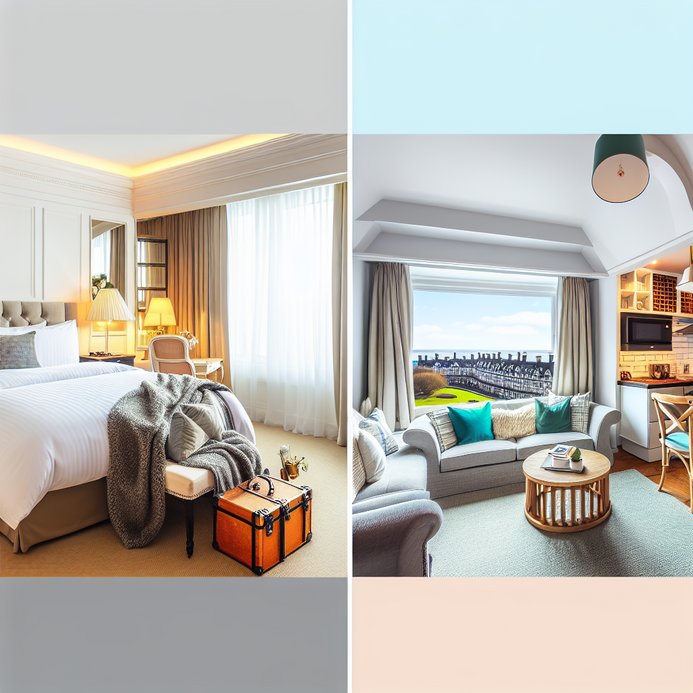
Alt: “modern-apartment-rental-versus-hotel-lobby-comparison”
Airbnb vs Hotel – Planning Your Stay
Your accommodation decision requires evaluating specific trip details. Group size is a major factor; rentals often become more economical for four or more people. Trip length matters, as rentals may offer weekly discounts, while hotels can provide better rates for short stays. Consider your daily agenda and whether you’ll cook meals or prefer eating out.
Location needs are crucial. Hotels cluster in tourist and business districts, while rentals disperse into residential neighborhoods. This affects walkability to major sites. Finally, assess your need for hotel amenities like a 24/7 front desk, daily housekeeping, or a concierge versus the residential feel of a rental.
Best Scenarios for Choosing an Airbnb
Short-term rentals excel for extended stays, family travel, and destination immersion. They work best when you prioritize space, a kitchen, and a residential neighborhood feel. A rental is ideal for stays longer than four nights, as you can settle in and utilize laundry facilities.
Families benefit from separate bedrooms and a living area. Travelers aiming to live like a local appreciate shopping at neighborhood markets. Groups splitting costs find renting a large home more affordable than booking multiple hotel rooms.
Best Scenarios for Choosing a Hotel
Hotels are superior for short trips, business travel, and when convenience is paramount. They provide immediate solutions upon arrival and predictable service. For trips under three nights, the streamlined check-in and lack of cleaning duties are advantageous.
Business travelers need reliable Wi-Fi, workspaces, and central locations. Solo travelers or couples often find better last-minute deals on hotel rooms. Anyone valuing amenities like a pool, gym, or daily breakfast will prefer the hotel model.
Essential Booking Checklist
Always compare the total cost, including all fees. For rentals, calculate cleaning fees, service charges, and potential security deposits. For hotels, check resort fees, parking costs, and breakfast inclusion. Read recent reviews focusing on cleanliness, accuracy of descriptions, and host or staff responsiveness.
Comparing Costs and Hidden Fees
A direct price comparison requires looking at the final total, not just the nightly rate. Vacation rental listings show a base price, but mandatory cleaning fees and service charges are added later. These can increase the total cost by 20-50%, especially for short stays. Hotels quote rates that typically include everything except optional incidentals.
Additional costs exist for both. Rentals may require a security deposit hold. Hotels often charge for parking, Wi-Fi, and resort fees. For a fair analysis, use each platform’s total price calculator before booking. Always factor in your spending on meals, as a rental kitchen can significantly reduce food costs.
Breaking Down the True Price
For a three-night stay, a $150/night rental might have a $100 cleaning fee, making the total $550. A hotel at $180/night might have a $30/night resort fee, totaling $630. The rental appears cheaper initially but is closer in final price. However, the rental’s kitchen could save a family $100 on meals, making it the better value.
Longer stays dilute fixed rental fees. A week in the same rental costs $1150 ($150 x 7 + $100 fee). The hotel week costs $1470 ($210 all-in x 7). The rental’s value increases with duration. Always calculate the per-person cost for groups to see the clearest financial advantage.
Value Beyond the Price Tag
Value encompasses experience, not just cost. Hotels offer value through time savings, convenience, and service. You don’t need to coordinate check-in, buy toiletries, or take out trash. This can be invaluable on a busy trip. Rentals offer value through space, privacy, and a local living experience you can’t get in a hotel.
Privacy, Space, and Amenities Analysis
Privacy definitions differ. In a rental, you have a completely private dwelling, which is a significant advantage for families or groups. In a hotel, your room is private, but you share hallways, elevators, and common areas with other guests. Space is a clear win for rentals, offering separate living, dining, and sleeping areas.
Amenities vary widely. Hotels provide consistent amenities like gyms, pools, business centers, and daily housekeeping. Rentals offer residential amenities: full kitchens, laundry machines, and often outdoor spaces like patios or yards. Weigh which amenities are essential versus nice-to-have for your specific trip.
Hotel Amenities and Services
Standard hotel services include a 24/7 front desk for assistance, daily housekeeping, and often luggage storage. Upscale properties add concierge services, room service, valet parking, and spa facilities. These services reduce traveler workload and solve problems quickly, contributing to a seamless, restful experience.
On-site restaurants and bars provide dining convenience. Business centers and meeting rooms cater to professional needs. Loyalty programs offer perks like room upgrades, late checkout, and points redeemable for future stays. This ecosystem of service is the hotel’s core product.
Rental Amenities and Livability
A full kitchen is the most significant rental amenity, allowing for coffee, simple breakfasts, and home-cooked meals. This is a major cost-saver and convenience for families with dietary restrictions. In-unit laundry is a game-changer for long trips or traveling with children, reducing luggage needs.
Multiple bathrooms, common living areas, and outdoor space enhance comfort for groups. These features transform your lodging from a place to sleep into a place to live. However, quality and provision of amenities (like coffee, shampoo, or hair dryers) are less consistent than in hotels and depend entirely on the host.
Practical Travel Considerations
The booking and stay process differs substantially. Hotel bookings are instant and standardized. Rental bookings often require host approval, which can take hours or days. Check-in at a hotel is at a front desk; rental check-in may involve lockboxes, keypads, or meeting a host, which can be cumbersome after late-night travel.
During your stay, hotel staff are on-site to address issues immediately. For a rental, you contact the host, who may or may not be responsive. This makes hotels a safer bet for travelers who prioritize predictability and immediate problem resolution above all else.
| Accommodation Type | Key Features & Considerations | Average Nightly Price Range (USD) |
|---|---|---|
| Budget Hotel Chain | Basic room, often near highways or airports, limited amenities, predictable cleanliness. | $60 – $110 |
| Mid-Range Full-Service Hotel | On-site restaurant/bar, fitness center, pool, business services, central location. | $130 – $250 |
| Entire Apartment (Airbnb/Vrbo) | Full kitchen, living space, washer/dryer, residential neighborhood, host-dependent service. | $90 – $300 (varies by city) |
| Luxury Hotel or Resort | Premium service (concierge, spa), fine dining, prime location, high-end finishes, loyalty programs. | $300 – $800+ |


