

Best Seat Selection When Flying With Children
Choosing the right airplane seats is one of the most impactful decisions you can make for a smoother family flight. The best seat selection when flying with children balances quick aisle access, proximity to lavatories, and minimizing disruption to other passengers. Your choice depends heavily on the children’s ages, the aircraft layout, and whether you’re traveling with one or two adults, requiring strategic planning from the moment you book.
Essential Factors for Family Air Travel
Family air travel involves unique logistical challenges that savvy seat selection can significantly ease. The primary goals are maintaining parental control, ensuring child safety, and creating a contained environment for snacks, toys, and naps. Aircraft configuration varies widely, so checking your specific plane’s seat map on websites like SeatGuru before choosing is non-negotiable.
Traveling with infants differs vastly from flying with toddlers or school-aged children. Each age group has distinct needs regarding space, bathroom independence, and entertainment. Airlines have specific rules about where infants in bassinets can sit and which seats are considered emergency exit rows with age restrictions.
Understanding Aircraft Layout and Key Zones
Not all sections of an aircraft are created equal for family comfort. The front of the economy cabin often boards and deplanes faster, reducing time in crowded aisles. However, bulkhead rows at the very front of a section offer fixed armrests and no under-seat storage during takeoff and landing, which can be a major inconvenience.
- Bulkhead Rows: These offer extra floor space for toddlers to stand and are the only rows where airlines can attach a bassinet for an infant. The trade-off is that all carry-on bags must go in the overhead bins during critical flight phases.
- Standard Rows: Rows with seats directly in front of you provide under-seat storage for a crucial diaper bag or backpack of activities, keeping essentials within instant reach throughout the flight.
- Rear of the Aircraft: These seats are typically closer to the lavatories, which is helpful for potty-training children. They are also often closer to the galley where flight attendants can sometimes provide extra assistance.
- Basic Economy/Budget: ($0 – $30 per seat): You’ll be assigned seats at check-in, often resulting in being separated. This is highly risky for families. Only choose this if the airline guarantees children will be seated with at least one parent.
- Standard Economy/Mid-Range: ($10 – $50 per seat per leg): This tier allows you to select standard seats at booking. Aim for aisle-window pairs toward the middle or back of the cabin where you’re more likely to have an empty middle seat between you.
- Preferred/Extra Legroom/Luxury: ($50 – $200+ per seat): This includes bulkhead rows, exit rows (for older children), and seats with up to 6 inches more legroom. The cost is significant but can be worthwhile for flights over 4 hours, providing crucial space for children to play on the floor or for installing a car seat more easily.
- FAA: Flying with Children
- U.S. DOT: Family Seating Dashboard
Age-Specific Considerations
Your children’s ages will dictate the optimal seating strategy. A lap infant under two has different requirements than a restless four-year-old. Safety regulations also play a role, as car seats must be installed in window seats to not block evacuation paths.
For toddlers and preschoolers, aisle access is paramount for frequent bathroom trips and brief walks to break up the journey. For school-aged kids, having their own dedicated entertainment screen and a window view can be a wonderful distraction. Always consider each child’s personality and needs individually.
Traveling as One Adult vs. Two Adults
The number of adults in your travel party dramatically changes the seating calculus. A solo parent with two young children faces a different set of challenges than two parents traveling together. The configuration must allow at least one adult to easily assist each child without climbing over strangers.
For a single adult with multiple children, securing seats in a single row is often the best, if not only, option. For two adults, more strategic arrangements are possible, including splitting up across an aisle or even taking rows in front and behind each other to manage different child moods and sleep schedules.
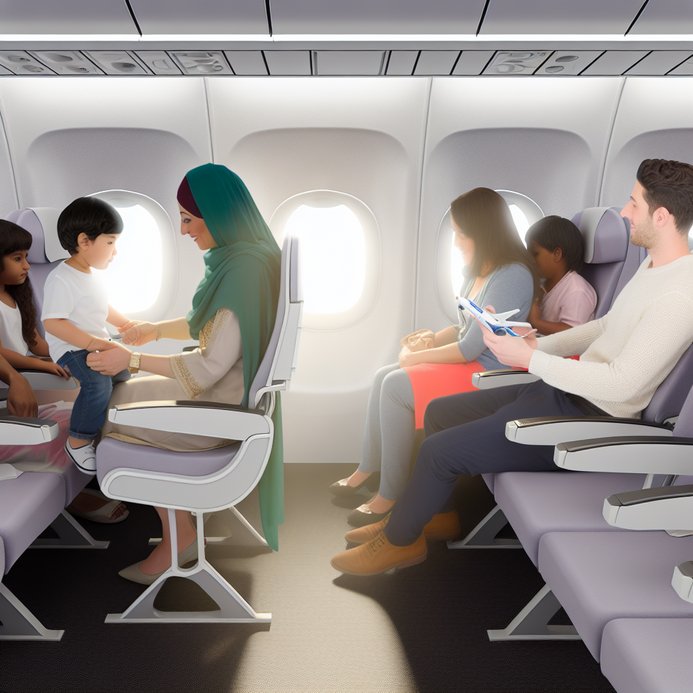
Alt: “family-airplane-seats-children-aisle-window-travel”
Best Seat Selection When Flying With Children – Planning Your Strategy
The optimal seat selection when flying with children is not a single seat but a strategic plan tailored to your family’s specific trip. This involves booking early to have the widest choice, understanding airline policies for family seating, and sometimes paying a premium for seats that guarantee your configuration. Airlines often release their cheapest basic economy fares that don’t include advance seat selection, which is a false economy for families.
Many carriers now have formal family seating policies, especially for young children. The U.S. Department of Transportation encourages airlines to seat young children next to a parent at no extra cost. However, you must often contact the airline directly after booking to arrange this, as automated systems may not link the reservations properly.
Your budget will influence your options. Paying for preferred seats with extra legroom or selecting seats in a premium cabin can transform the journey. For long-haul flights, this investment is often worth the extra cost for the additional space and peace it provides to both your family and fellow passengers.
Best Time to Book and Select Seats
Book your family flights as early as possible, ideally as soon as schedules are released 6-11 months in advance. Seat selection typically opens immediately after booking for most standard fares. The prime family-friendly seats—like bulkhead rows or rows with empty middle seats—are the first to be taken.
If you cannot get ideal seats at booking, check the seat map again 24-72 hours before departure during online check-in. This is when elite frequent flyer seats are often released and when the airline’s operational team finalizes the aircraft layout, sometimes opening up better rows. Be polite but firm at the airport gate if your seats are still separated.
Budget Planning for Seat Selection
Fees for advanced seat selection have become standard. Factor these into your overall flight budget from the start.
Essential Preparation Checklist
Before you even look at a seat map, gather your information. Have your children’s ages, heights, and any special needs noted. Know the exact make and model of any FAA-approved car seat you plan to bring, as its dimensions will determine if it fits in a particular airline seat.
Call the airline after booking to confirm their family seating policy and have your reservations linked. Pack a separate, lightweight bag for under-seat essentials: diapers, wipes, a change of clothes, snacks, and small toys. Confirm your seat choices 24 hours before departure and have a backup plan ready to propose at the gate if needed.
Top Recommended Seat Configurations
Based on common family structures and aircraft layouts, several configurations consistently prove most effective. The classic “two on the sides” approach involves booking an aisle and a window seat in a three-seat section, hoping the middle seat remains empty. If someone is assigned that seat, they are often willing to swap for your aisle or window.
For two adults and two children, consider taking two pairs of seats across the aisle from each other. This allows one adult to manage each child easily and permits swapping kids or adults mid-flight without disturbing others. The bulkhead row can be ideal for parents with a lap infant who needs a bassinet, despite its storage drawbacks.
Must-Try Configurations by Family Size
For one adult and one child, an aisle seat for the parent and a window seat for the child is ideal. The child is contained against the window, and the parent has easy aisle access. For one adult with two children, a full row of three seats is mandatory to maintain control and avoid asking strangers to swap.
For two adults and one child, the “triangle” works well: one adult takes the window, the child the middle, and the other adult the aisle. This surrounds the child with parents. For two adults and two or more children, combining rows (e.g., one adult and child in row 10, another adult and child directly behind in row 11) can provide more space and separation when needed.
Seats to Avoid With Kids
Some seats are particularly poor choices for family travel. Avoid the last row of any section, as these seats often do not recline, leading to uncomfortable children. Be cautious of seats immediately in front of an exit row, as the recline function is usually disabled.
Think twice about sitting in the very last row of the plane adjacent to the lavatories; the constant foot traffic, slamming doors, and smell can disrupt sleep. Also, avoid middle seats in the center section of a wide-body plane (like a 777 or 787), as you could be up to two seats away from any aisle, making exits with a child slow and difficult.
Utilizing Bulkhead and Bassinet Rows
Bulkhead rows, the first row after a physical divider, are a double-edged sword. They offer invaluable floor space for a toddler to play quietly and are the exclusive location for attaching airline-provided bassinets for infants. These bassinets have weight limits (typically 20-25 lbs or 9-11 kg) and length restrictions.
You must request a bassinet when booking and confirm at check-in. The major downside is that during taxi, takeoff, and landing, all personal items must be stowed in the overhead bins. This means your critical diaper bag and toy bag are inaccessible for roughly 45 minutes at the start and end of the flight.
Practical Travel and Booking Information
Navigating airline policies and booking systems requires a clear strategy. Major U.S. carriers like Delta, American, and United have pledged to keep young children seated with a parent. Budget and international carriers may have stricter rules and fees. Always read the fine print on family seating before purchasing the cheapest fare.
When booking online, use the “manage my booking” feature immediately after purchase to select seats. If your desired configuration isn’t available, call the airline’s reservation line. Agents often have access to seat inventory that isn’t displayed online and can manually assign seats to keep your family together, especially if you cite the airline’s own policy.
| Airline Type | Typical Family Seating Policy | Seat Selection Fee Range (USD) |
|---|---|---|
| Major U.S. Carrier (Delta, American) | Guarantees adjacent seats for children under 15 with an adult; contact if not available. | $0 – $75+ (Standard to Preferred) |
| Low-Cost Carrier (Spirit, Frontier) | Often charges for all advance seat selection; families may be separated if they don’t pay. | $5 – $50 per seat per segment |
| International Full-Service (Lufthansa, Singapore Air) | Generally good policies for families; bassinets on long-haul; may block middle seat for infants. | Included in fare or $30 – $150 |
| International Budget (Ryanair, EasyJet) | Paid seat assignment is mandatory to sit together; strict enforcement at the gate. | $4 – $30 per seat per flight |


